
 Teltonika Networks product
5G routers
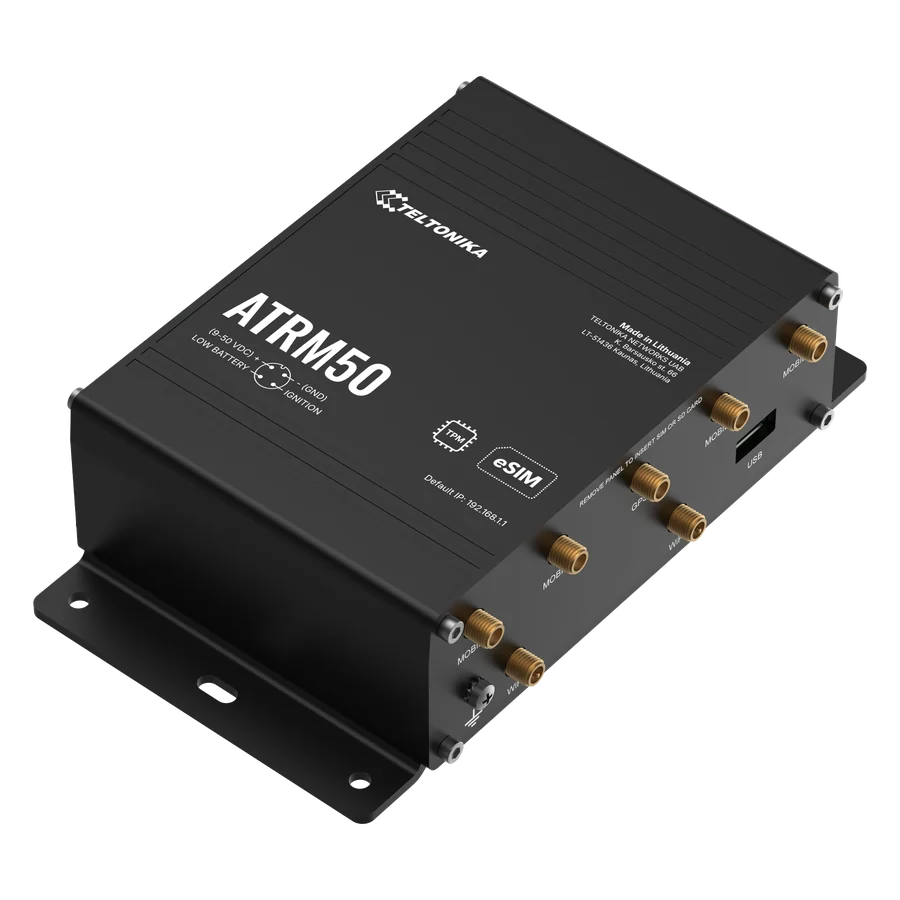
ATRM50
Railway-grade rugged 5G router
This model is quoted as a project: email us and we will confirm supply and compatibility, then come back with a firm price.
Key specifications
- 4× M12 X-coded Gigabit Ethernet + M12 power
- 5G: up to 3.4 Gbps · dual SIM + eSIM
- Built-in GNSS · Wi-Fi 5
- EN 50155 / EN 45545-2
- Country of origin: Lithuania
- Operating temperature: -40 °C to 75 °C
Download spec sheet (PDF)
Sign in to download the specification PDF.
Send the model, quantity and application and we will reply with supply arrangements and a quotation.
Full specifications
Reproduced from the official manufacturer specifications; the published figures prevail. Official specifications
Physical specification
- Casing
- Anodised aluminium housing and panels
- Dimensions
- 167 × 46.2 × 112.4 mm
- Weight
- 550 g
- Mounting
- Flat surface
Power
- Connector
- M12 A-code 4-pin male
- Input voltage
- 9–50 VDC, reverse polarity & overvoltage (70 V) protection
- Consumption
- Idle < 5.5 W, max < 16 W
Physical interfaces
- Ethernet
- 4× M12 X-code 8-pin female, 10/100/1000 Mbps
- SIM
- 2× Mini SIM (2FF), 1.8/3 V
- Antennas
- 4× SMA (mobile), 2× RP-SMA (Wi-Fi), 1× SMA (GNSS)
- Other
- 1× USB-A, reset button, grounding screw, status LEDs
Mobile
- Mobile module
- 5G Sub-6 GHz SA/NSA: 3.4 Gbps DL (4×4 MIMO), 550 Mbps UL (2×2 MIMO)4G LTE Cat 19: 1.6 Gbps DL, Cat 18 200 Mbps UL3G: 42 Mbps DL / 5.76 Mbps UL
- 3GPP Release
- Release 16
- eSIM
- Consumer eSIM, profile download/removal, up to 7 profiles (no data plans included)
- SIM switch
- Dual SIM + eSIM, auto-switch on: weak signal, data/SMS limit, roaming, no network, network denied, data connection fail
- Status
- IMSI, ICCID, operator, network type, CA, bandwidth, band, RSSI, SINR, RSRP, RSRQ, cell ID, data counters, MCC/MNC
- SMS
- SMS status/config, email↔SMS, SMS to HTTP, scheduled SMS, autoreply, SMPP
- USSD
- Send and read USSD messages
- Block/Allow list
- Operator allow/block list (by country or operator)
- Multiple PDN
- Different PDNs for multiple network access and services
- Band management
- Band lock, used-band status display
- SIM idle protection
- Periodically switch to unused SIM to prevent blocking
- SIM PIN management
- Set, change or disable SIM PIN
- APN
- Auto APN
- Bridge / Passthrough / Framed routing
- Bridge between mobile ISP and LAN; passthrough of WAN IP; framed routing behind 5G UE
Wireless
- Wireless mode
- 802.11b/g/n/ac Wave 2 (Wi-Fi 5), up to 867 Mbps, dual-band, MU-MIMO
- Wi-Fi security
- WPA2/WPA3-PSK, WPA2/WPA3-Enterprise (PEAP, EAP), OWE; AES-CCMP, TKIP; PMF 802.11w
- SSID / ESSID
- SSID stealth, MAC access control
- Wi-Fi users
- Up to 150 simultaneous connections
- Connectivity features
- Mesh (802.11s), fast roaming (802.11r), 802.11k/v, Relayd
- MAC filter
- Allowlist, blocklist
- QR code
- Wireless QR code generator for instant onboarding
- TravelMate
- Forward Wi-Fi hotspot landing page to a downstream device
Ethernet
- WAN
- 1× 10/100/1000 Mbps, IEEE 802.3/u/az, auto MDI/MDIX
- LAN
- 3× 10/100/1000 Mbps, IEEE 802.3/u/az, auto MDI/MDIX
Network
- Routing
- Static, dynamic (BGP, OSPFv2, RIP v1/v2, EIGRP, NHRP), policy-based routing
- Protocols
- TCP, UDP, IPv4, IPv6, ICMP, NTP, DNS, HTTP(S), FTP, SMTP, SSL/TLS, ARP, VRRP, PPP, PPPoE, UPnP, SSH, DHCP, Telnet, SNMP, MQTT, WOL, VXLAN
- VoIP passthrough
- H.323 and SIP-alg NAT helpers
- Connection monitoring
- Ping/Wget/Periodic reboot, LCP and ICMP link inspection
- Firewall
- Port forward, traffic rules, custom rules, TTL customisation
- DHCP
- Static/dynamic IP, DHCP relay, static leases with MAC wildcards
- QoS / SQM
- Traffic priority by source/destination, service, protocol or port; WMM, 802.11e
- DDNS / DoH
- 77+ DDNS providers; DNS over HTTPS proxy
- Backup & load balancing
- Wi-Fi WAN, mobile, VRRP, wired failover; multi-WAN load balancing
Security
- Authentication
- PSK, X.509 certificates, TACACS+, RADIUS, IP & login-attempt blocking, time-based login blocking
- Firewall / DMZ / NAT
- WebUI rules, unlimited CLI rules, DMZ, NAT, NAT-T, NAT64
- Attack prevention
- DDoS (SYN flood, SSH/HTTP(S)), port scan prevention
- VLAN
- Port and tag-based VLAN
- Mobile quota
- Data limit, customisable period, warning limit, phone number
- WEB filter
- Blocklist and allowlist
- Access control
- Flexible SSH, WebUI, CLI, Telnet access control
- TPM
- TPM 2.0
- Certificate Manager
- CA, server, client, Let’s Encrypt, SCEP certificates
VPN
- OpenVPN
- Multiple clients + server, 27 encryption methods
- IPsec
- XFRM, IKEv1/IKEv2, 14 encryption methods (3DES, DES, AES128/192/256 + GCM)
- GRE / PPTP / L2TP
- GRE, GRE over IPsec; PPTP/L2TP client+server, L2TPv3, L2TP over IPsec
- Others
- Stunnel, DMVPN (Phase 2/3, dual hub), SSTP, ZeroTier, WireGuard, Tinc, Tailscale
Industrial protocols
- BACnet
- Router mode, IP/RTU(USB), multiple BACnet/IP interfaces, BBMD
- OPC UA
- Client, Server (TCP)
- MODBUS
- Server/Client (TCP, USB), custom registers, 8/16/32-bit formats (HEX, ASCII)
- DNP3
- Station / Outstation (TCP, USB)
- DLMS/COSEM
- Client (TCP)
- Data to Server
- HTTP(S), MQTT, Azure MQTT; custom LUA scripts
- MQTT Gateway
- Modbus MQTT gateway
Monitoring & management
- WebUI
- HTTP/HTTPS, status, configuration, FW update, CLI, logs
- FOTA / SSH
- Server firmware update + notifications; SSH v1/v2
- SMS / Call
- SMS status/config; call reboot/status/data/Wi-Fi on-off
- TR-069 / SNMP / MQTT / JSON-RPC
- OpenACS, GenieACS etc.; SNMP v1/v2/v3 + trap; MQTT broker/publisher; JSON-RPC API
- RMS
- Teltonika Remote Management System
IoT platforms
- Supported
- ThingWorx, Cumulocity, Azure IoT Hub, AWS IoT Core
System characteristics
- CPU
- MediaTek dual-core 880 MHz, MIPS1004Kc
- RAM
- 256 MB DDR3
- Storage
- 16 MB NOR flash + 256 MB NAND flash
- OS
- RutOS (OpenWrt-based Linux)
Location tracking
- GNSS
- GPS, GLONASS, BeiDou, Galileo, QZSS
- Features
- NMEA 0183, NTRIP, geofencing, coordinates via WebUI/SMS/TAVL/RMS
I/O & USB
- Inputs
- 2× input (ignition detection / low battery)
- USB
- USB 2.0, Samba share, USB-to-serial, external HDD/modem/printer
- SD card
- Micro SD up to 2 TB, Samba share
Operating environment
- Temperature
- -40 °C to 75 °C
- Humidity
- 10% to 90% non-condensing
- Ingress protection
- IP30
Standards applied
- Health and Safety — Article 3.1(a)
- EN IEC 62311:2020EN 50665:2017EN IEC 62368-1:2020 + A11:2020
- Electromagnetic Compatibility — Article 3.1(b)
- EN 55032:2015 + A11:2020 + A1:2020EN 55035:2017 + A11:2020EN IEC 61000-3-2:2019 + A1:2021EN 61000-3-3:2013 + A1:2019 + A2:2021EN 301 489-1 V2.2.3EN 301 489-17 V3.2.4EN 301 489-52 V1.2.1
- Efficient Use of Radio Spectrum — Article 3.2
- EN 300 328 V2.2.2EN 301 511 V12.5.1EN 301 908-1 V15.2.1EN 301 908-2 V13.1.1EN 301 908-13 V13.2.1
- Cybersecurity Requirements — Article 3.3(d), (e)
- EN 18031-1:2024EN 18031-2:2024
- EU Type Examination Certificate
- Articles 3.1(a), 3.1(b), and 3.2 — No. NB2906.2024.000012
Compliance
Frequently asked questions
What is the operating temperature range of the ATRM50?
The ATRM50 operates from -40 °C to 75 °C.
What certifications does the ATRM50 have?
The ATRM50 carries certifications including CE/RED, Railway, UKCA; see the full list on this page.
Where is the ATRM50 made?
The ATRM50 is designed and made by Teltonika Networks in Lithuania.
Is the ATRM50 covered by a warranty?
Hardware warranty follows Teltonika Networks terms and the model; GNS helps process claims within the warranty period.
Related products
Not sure which model fits?
Tell us your application, quantity and certification requirements and we will recommend the right models and quantities.
Contact usYour cart ·
Your cart is kept for seven days. At checkout, pay by card (+3.5% surcharge) or by bank transfer / FPS.